


Controlling Your Pain
Your comfort is very important to us.
Your comfort is very important to us. You have the right to the appropriate assessment and management of your pain. Pain management is a necessary part of your treatment plan. We ask that you discuss pain relief options with your physician, ask for pain relief options when pain first begins, tell us when pain is not relieved, and tell us about any concerns you have to help your doctor and nurse assess your pain.
Cooper University Hospital offers a presentation on pain management. To view this presentation on your television, dial extension 4999, code #630.
Types of Pain Medicine
Intravenous pain medicine comes into your body through a tube, often in your arm. This provides fast relief, often within 15 minutes.
Epidural pain medicine is given through a small tube (catheter) which is inserted in your back. It is typically used when you have surgery on the lower part of your body. Usually relief is constant.
Oral pain medicine is given by the mouth in tablet or liquid form. Oral medicines are used when other medicine is no longer needed (24 to 48 hours after surgery). It can also be used before physical therapy or a medical procedure that might cause discomfort. You usually feel better within 30 to 45 minutes.
Patient-controlled analgesia (PCA) uses a computerized pump to send pain medicine directly into your blood stream. When you need pain relief, you can give yourself pain medicine by pressing a button or switch. The pump does not allow you to get too much and relief is usually steady. Your doctor or nurse can change the allowed dose if you are not finding relief.
Rate Your Pain
The best way we will know when you have pain is for you to tell your doctors, nurses and therapists:
- Where you are hurting? Point to or describe the place(s) where it hurts.
- What the hurt feels like? Use words like aching, burning, cramping, deep, dull, gnawing, pinching, pounding, pressing, prickling, pulsing, sharp, shooting, stabbing, tight, tender, or throbbing to describe your pain. This will help us decide which medications or treatments are best for you.
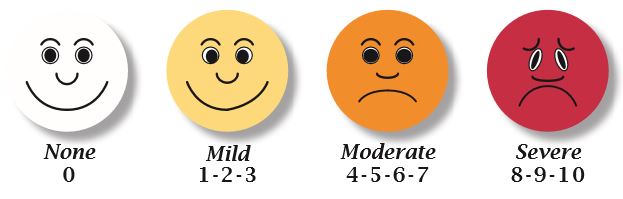
- How much you are hurting? Rate your pain on a scale from 0 to 10, with 0 meaning no pain, and 10 meaning the worst pain you can imagine. Reporting your pain as a number lets us know how well your treatment is working. You can also rate your pain with the faces or by using words such as mild, moderate, or severe.
Keeping Pain in Control
Do not wait for the pain to get bad. Ask for pain medicine before pain starts or when it first begins. It is easier to control pain when it is mild, before it gets severe. If you know your pain will get worse when you do certain physical activity, ask for your pain medicine first.
Possible Side Effects of Pain Medication
Side effects of pain medication that sometimes occur include:
- Nausea.
- Constipation.
- Sleepiness.
- Itchiness.
- Difficult urination.
If you are bothered by any of these side effects, or if your IV is painful, tell your nurse and doctor.
Other Ways to Relieve Pain
- Hot/cold packs.
- Music.
- Relaxation.
- Reading.
- Changing positions.
- Watching TV.