


Extra-Corporeal Membrane Oxygenation (ECMO) Therapy
South Jersey’s first and only ECMO program offering advanced therapy for critically ill patients.
For more information, call 856.968.1649
As a recognized leader in critical care training, Cooper University Health Care is home to South Jersey’s first and only formal extracorporeal membrane oxygenation (ECMO) program, giving the region’s residents access to this lifesaving therapy closer to home.
ECMO is an advanced therapy used to support patients with severe lung failure or critical heart-lung conditions. At Cooper, ECMO is used in the Intensive Care Unit (ICU) to temporarily take over the function of the lungs so they can rest or heal.
ECMO does not cure the underlying condition but provides time for recovery by delivering oxygen to the blood and removing carbon dioxide when the lungs cannot.
Who May Benefit From ECMO?
A patient may be a candidate for ECMO if they have a condition that is potentially reversible and treatable and has not improved with other treatments. Some common conditions that may benefit from ECMO are:
- Acute respiratory distress syndrome (ARDS)
- Severe pneumonia or influenza
- Conditions causing severe heart failure
- Pulmonary embolism
- Severe asthma
- Complications after heart surgery
How ECMO Works
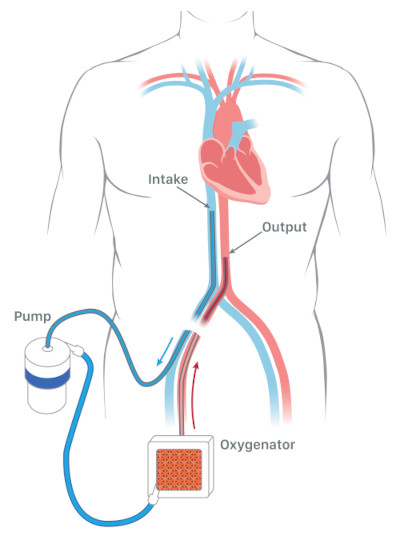
ECMO uses tubes called cannulas placed into large blood vessels to circulate the patient’s blood through a machine outside of the body (called an ECMO circuit). ECMO works by removing blood from a large vein (through a cannula) and sending that blood through the ECMO circuit. This circuit pumps the blood through an oxygenator, which functions like a patient’s healthy lung. The oxygenator adds oxygen to the blood and remove carbon dioxide (CO2). The blood is warmed and then returned to the patient’s body through another cannula.
In some patients, the cannula draining blood is in the groin and the cannula returning blood to the patient is in a vein in the neck (see diagram).
In others, a single cannula with two openings may be used. One opening drains blood and the other allows blood to return to the patient after passing through the ECMO machine.
How Long Do Patients Require ECMO?
The amount of time a patient remains on ECMO depends on the underlying medical condition and the rate of recovery. As patients improve, ECMO support is gradually reduced for short periods in a process called weaning. This will allow the ECMO team to see how the lungs are recovering.
When no longer needed, the ECMO machine is turned off and the cannulas are removed, either in the ICU or in the operating room, depending on the patient’s needs.
A Comprehensive ECMO Care Team
Providing ECMO therapy requires a highly coordinated, multidisciplinary team of specialists committed to delivering academic-level critical care. The Cooper team includes:
- Intensive care physicians
- ECMO physicians
- Cardiothoracic surgeon and/or cardiologist
- ECMO perfusionist
- Critical care nurses
- Respiratory therapists
- Pharmacists
- Social workers
- Dieticians
- Physical therapists
- Other sub-specialists including infectious disease, pulmonary, nephrology, and others as needed for optimal care
- Spiritual support